By Tânia de Chiaro*
One of the key aspects of ESP, English for specific purposes, is the needs analysis. Although it is not exclusive to ESP, the needs analysis has become more visible due to its extensive use in designing English courses for business in Brazil.
A thorough needs analysis is a great tool that enables the teacher to design the course that will meet this student’s specific needs. One of the outcomes of the needs analysis is a vocabulary list with essential words and expressions. Working on this list may represent a challenge for the teacher or course designer since some words are not part of our everyday vocabulary. Getting ready to teach this ESP student demands some careful research.
Most words in this vocabulary list will probably come in their mother tongue, in this case, Portuguese. I now suggest a categorization of this vocabulary list and give you some examples on each category. The examples are based on a food and beverage course, a business sector that involves people who work in catering, restaurants and bars.
· Some of these words and expressions are either known or will be easily found in dictionaries, general or specialized in the area you are designing the course for. Fruit and vegetables that are part of our everyday life as well as cutlery and china items are good examples of these words.
· Another group of words and expressions will probably demand a little more research time. In this case, checking specific websites in which you can find the words in context, searching for images to check meaning, reading manuals originally written in the target language, asking a native speaker, checking when and in which circumstances the words occur are some of the strategies you can use. I suggest you use more than one strategy just to cross reference the information you get. For instance, knowing that ‘flank steak’ is fraldinha, ‘hump’ is cupim (meat cuts) and the right term for carne seca is ‘jerked beef’ and not ‘dried meat’ might require a little more research.
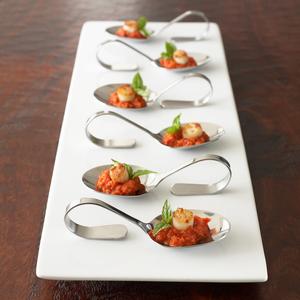
· Some of these words are already known and used by your student in the target language on the job as technical terms. I suggest you take some time to check if their meaning really applies when speaking English. A good example is the ‘amuse-bouche’ (originally a French term, it is also used in English and Portuguese with the same meaning). The students will know and can teach you that ‘amuse-bouche’ is a small individual serving of food usually offered to the customers by the chef before the starter in fine restaurants as a treat. The meaning of the expression is literally “to amuse the customers’ mouth”. Another good example is the word ‘amenity’. In the hospitality industry, it’s used in Portuguese in the plural as a synonym to toiletry items. In English, it may have several meanings, including the one used in Portuguese. You have to be aware of that to be able to warn your students.
· Last but not least, there are a number of words and expressions that are usual in Portuguese but would rarely be used or understood by speakers of English, and this is something you also have to inform your student. Couvert as it is used in Portuguese does not exist in English. Adapting the sentence or explaining it to the customer are some options to guarantee comprehension. The intention behind saying something similar to Volte sempre in English at the end of a meal will hardly be grasped by the English speaker. Options such as ‘I hope you enjoyed your meal’ or ‘We hope to see you again’ (if restaurant procedure allows) are more likely to succeed. In any case, a simple and honest ‘Have a good night!’ after a fine dinner would suffice.
Reference: Inglês para restaurantes
Author: Tânia de Chiaro
Tânia Regina Peccinini De Chiaro é graduada em Letras pela FFLCH e mestre na área de linguagem e educação pela Faculdade de Educação, ambas da USP. Como diretora da Link English Projects, desenvolve projetos corporativos de capacitação profissional para o atendimento de clientes estrangeiros em inglês e cuida da capacitação de professores. Tânia é autora de Inglês para restaurantes e Inglês para hotelaria pela Disal Editora.
.JPG)
View Comments
Very interesting and important for efl teachers. Language is such a complex subject that we must be aware of those differences in order to be successful when teaching.