

Last month I delivered a workshop at Disal in São Paulo, where a great group of teachers and I discussed the used of authentic materials before advanced levels. By authentic materials, we mean texts (written or spoken) that were not designed for pedagogical purposes, so we can include under this umbrella term a myriad of types of materials that are becoming more and more present in our students’ lives and in the EFL classroom, such as scenes of films and series, actual TV or radio broadcasts, magazine or newspaper stories and so on.
There are no limits to the amount of material available online, and most teachers seem comfortable using them with high-level learners. It is how to make use of them with elementary and intermediate students, however, that is a daunting task for many of us.
It is often the case that we, as teachers, adapt articles and other sources of written texts to make their understanding by learners more attainable somehow. We’ve been doing it for a long time and it poses very little technical challenge. Using TV news, scenes from films and other types of video, however, is basically impossible!
One option is to go over hours and hours of material until you find snippets containing language that is accessible to those students, such as the first 30 seconds of this scene from the TV series F.r.i.e.n.d.s., which contains relatively simple language for introducing people:
Finding scenes like that require a lot of time dedicated to research, though, and it may be unpractical.
A valuable alternative is to grade the task. Help your students focus on the piece of information they need to understand rather than all the language that is beyond their current abilities. Take Jennifer Lawrence’s biography below, from the website biography.com:
https://www.biography.com/people/jennifer-lawrence-20939797
Even though it contains a number of lexical items and structures that elementary learners might not be able to grasp on their own, questions that focus on the information they can get (e.g. “Where is she from?”, “Does she have a big family?” “What six films are mentioned in the first paragraph?”) might provide your learners with reading strategies (e.g. ignoring unfamiliar words and inferring meaning) that could help them become more autonomous.
It is crucial, however, to be aware of your students’ own affective factors when planning how to use authentic materials such as these. Although dealing with real-life texts can on the one hand, promote sense of progress and boost learners’ self-esteem, the opposite is also true, since traumatic experiences and unrealistic expectations may lead to frustration and generate a lot of anxiety.
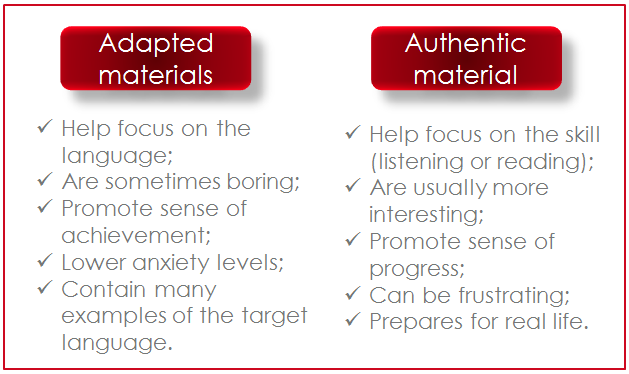
In a small-scale research I carried out with my own elementary groups, my students came up with valuable information on what they enjoy and don’t enjoy about both authentic and adapted materials:


