As I said in my August post, I feel it’s extremely important to encourage students to find their own purpose and usage to what they are learning. In my opinion, this is especially important for adults. They tend to get more involved with the learning process if they find purpose.
Something else that worries me sometimes is that, although we only divide the English language in topics for a pedagogical reason, we might have students who speak ‘in chapters’ if we don’t promote practice otherwise. I’ll try to explain…
If you follow a course book or produce your material, there‘s always the need to divide content in teachable parts, I understand that. But how often do we remember to gather them?
This month, let’s focus on possibilities to gather topics that along the course were presented in different ‘compartments’. If you already do this, maybe these ideas can be added to your practice. If you haven’t thought about it, why don’t you read on to see if you get inspired?
These language practices can, for example, be based on FUNCTIONS. Let’s have a look at some ideas to encourage students to join contents from different units or chapters for a communication purpose. These ideas can be carried out in groups or in pairs. You can also observe students’ mistakes and correct them at the end or as you wish. Remember, these are just some ideas to inspire you…
1. You can write the functions learned so far on slips of paper, shuffle and distribute among students. You should give more than one function to each pair/group. With the functions in hands, students should get organized to create a dialogue that includes all the functions. Once they are ready, they can present the dialogue to the class. You could also have students write the dialogue they created. The greater the quantity of functions, the greater the challenge.
2. You can create a scenario where students have to put into practice different functions learned in different units or chapters. Write A’s and B’s roles on different pieces of paper, distribute them to students and have them interact. The information gap created by the scenario is very rich.
Let’s imagine your students have learned separately:
a. how to introduce themselves,
b. how to talk and ask about personal information and
c. how to ask and give directions to public places.
Look at an example on how to join these three functions.
A: You are travelling in an English speaking country and you need some information about the city you are visiting now. Think of 3 questions you need to ask. You are about to enter the information booth.
B: You work at an Information booth in a touristic city where a survey is being conducted by the city hall to increase tourism in the region. Before you answer any questions from any tourist who visits the booth, you must ask him / her some personal information to fill in a quick form about the tourist. Decide on which information is important for the city hall survey and put the survey into practice with the next tourist who comes into your Information booth.
3. Sometimes students learn to interact in a certain sequence. The idea of breaking that sequence freezes them. Use functions that wouldn’t go together to create improbable fun conversations. With your students relaxed, they can probably have better results. Having the students present the different situations to the whole group can also be lots of fun. Suppose your students know:
· how to talk and ask about personal information
· how to inform about abilities and
· how to talk about ingredients and recipes
Here is an idea:
A: You are going to be interviewed for a job, prepare to talk about yourself and your abilities. One of your hobbies is cooking. You know lots of recipes.
B: You work at the Human Resources department and are going to interview a candidate today. Ask about his / her experience and abilities. You also have a great problem at home. Your mother in law is coming to visit you and you would like to cook something nice but you don’t cook well.
A variation to this activity could be: You give the students the functions and have them create a context for this improbable conversation to happen.
4. Sometimes the functions are taught in a certain context and students have difficulty using them in a different context or to a different purpose. Imagine students learned to describe their homes and neighborhoods to friends. Set a different context and have them, for example, talk about it to a real estate agent in order to advertise their house for sale.
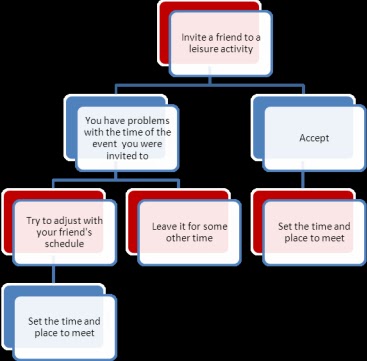
5. Building a flow chart helps students see the paths a conversation can take. Some course books bring them but you can also create your own. The visual aspect is very helpful especially to basic students. Here is an idea. Each color is a role: