

I recently gave a workshop at the UES Conference in Antalya in Turkey, sponsored by UES and Helbling Languages, and I would like to share with you a little experiment we conducted. The workshop is called – The Name of the Game – and aims to show how games provide intrinsic motivation and the indispensable joy of learning, especially for children.
Recent research findings show that children always learn and remember best when…
· they’re enjoying what they’re learning
· all their senses and emotions are engaged
· learning is active, experiential and social
· they interact with others – with you, in pairs, groups, teams
· the new language is meaningful, relevant and contextualized
· there is a challenge
To put some of these ideas to the test I decided to teach the participants, all Turkish native speakers, some words in Portuguese. First of all I gave them the list below of six randomly selected words with translation into English and gave them two minutes to memorize the words.
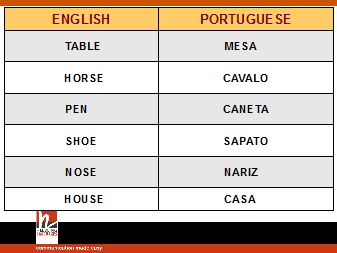
Next I showed them the flashcards below an
d we practised choral and individual repetition of the words in Portuguese, mixing up the order and using different intonation, silly voices and shouting or whispering to make the drill more fun and memorable. They loved shouting out – Fogo!
d we practised choral and individual repetition of the words in Portuguese, mixing up the order and using different intonation, silly voices and shouting or whispering to make the drill more fun and memorable. They loved shouting out – Fogo!
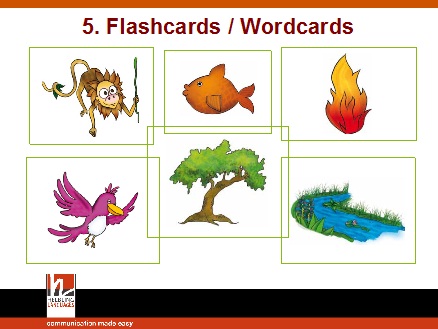
They also briefly saw the written words in a list, but only after they had practiced saying them.
I then gave out copies of these flashcards and told them I was going to read them a short story in English, called – The Big Fire.* I asked them to pay careful attention to the story and told them that if they heard the word for their flashcard while I was reading, they had to stand up and say the word in Portuguese. They really enjoyed this.
If I had had more time I could very easily have done lots of other fun, interactive, challenging and multisensory activities with the flashcards that would have engaged them emotionally. These kinds of activities can also be done before, during and after reading the story.
To test the efficacy of using the flashcards and fun activities, I first of all asked the teachers to tell me the Portuguese for the first list of words, which they only saw completely out of context and were given two minutes to memorize. Not surprisingly, the results were not good. When I then checked to see how well they had learned the words from the flashcards, the results were spectacular. Nobody in the group had any hesitation about saying the new words in Portuguese and with total confidence.
If you would like to find lots more fantastic ideas about how to use flashcards, visit the Helbling Languages website –
or use the link –
*The Big Fire – Rick Sampedro – Helbling Languages / Disal Editora


Jack Scholes has a first degree in German/Russian from Liverpool University, a Post-Graduate Certificate in Education and EFL from London University, and he is also a Licensed Master Practitioner of Neuro-Linguistic Programming. He has over 40 years experience in ELT and is now a freelance writer, trainer and ELT specialist.


